
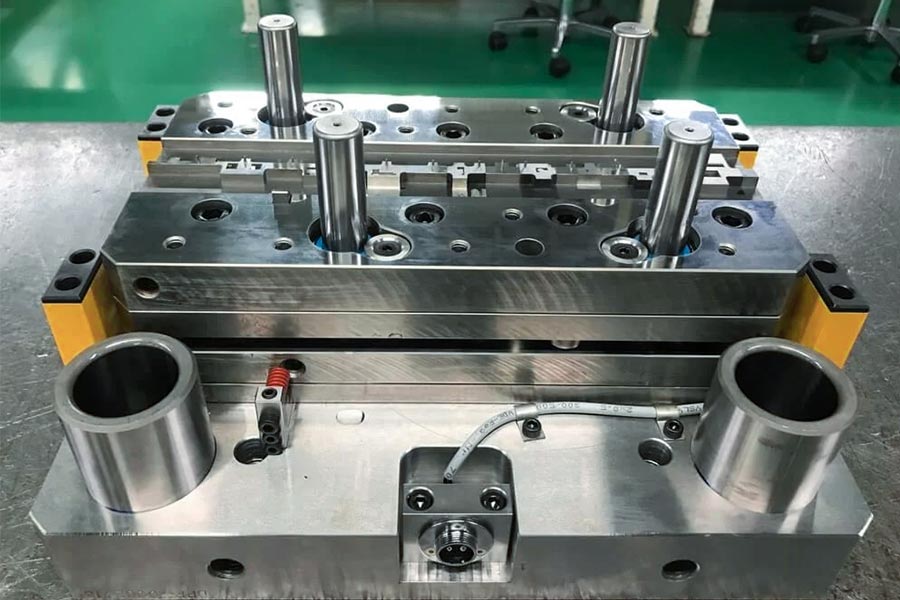
Introduction
Choosing between a progressive die and a conventional die is not just a technical decision—it is a strategic one that directly impacts costs, productivity, and scalability. Both options have their place. The key is understanding which one best fits your operation.
Key Difference Between Both Systems
- Progressive die: Multiple operations performed in a single, continuous run
- Conventional die: Individual operations performed in separate stages
Result:
One maximizes efficiency at scale; the other provides flexibility.
1. Initial Investment vs. Cost per Part
Progressive Die
- Higher initial investment
- Lower cost per part at high volumes
Conventional Die
- Lower initial investment
- Higher cost per part in continuous production
Conclusion:
The higher the volume, the stronger the case for a progressive die.
2. Production Volume
Progressive Die
- Ideal for mass production
- High repeatability
Conventional Die
- Better suited for low or variable volumes
- Batch production
Conclusion:
If your demand is consistent, the progressive die is the best choice.
3. Precision and Consistency
Progressive Die
- High part-to-part accuracy
- Reduced variability
Conventional Die
- Greater human intervention
- More variation between stages
Conclusion:
Progressive dies outperform in processes requiring strict repeatability.
4. Operational Flexibility
Progressive Die
- Less flexible for design changes
- Requires redesign for modifications
Conventional Die
- More adaptable
- Easier changes between operations
Conclusion:
If your product changes frequently, conventional dies offer an advantage.
5. Production Lead Time
Progressive Die
- Continuous production
- High-speed operation
Conventional Die
- Stage-by-stage processing
- Longer total production time
Conclusion:
Progressive dies significantly reduce lead times in sustained production.
Which One Makes More Sense Strategically?
Choose a Progressive Die if:
- You have high production volumes
- You aim to reduce cost per part
- You require consistency and speed
Choose a Conventional Die if:
- Your volume is low or variable
- You need flexibility
- You are in development or testing phases
Common Mistake to Avoid
Making the decision based solely on initial investment.
Instead, evaluate:
- Total cost of ownership
- Volume projections
- Product stability over time
Conclusion
There is no universally “better” option.
There is only the right option for your operation.
Making the right choice can be the difference between a profitable process and one constantly under cost pressure.
Not Sure Which Option Is Right for You?
Request a feasibility assessment at no cost and make a decision based on data—not assumptions.